I'd like to think I'm a sunny person, but there is a deep, dark streak in me. It's inherited from generations that came before who had to be on the lookout for every possible obstacle to crop success. From all my foremothers who watched their children die of diseases they could not treat, and forefathers who ate nothing but beans for months when times were hard, I have that ability to find the dark spot in the gratitude.
When I say that, I mean it's not just that I'm grateful that I get to take hot showers. It's that I also think, "I could totally slip and die in this shower. Nobody slipped and died in the metal tubs that held a couple inches of cold water for bathing back when my grandmommy was a little girl."(Although they did die of scarlet fever).
Motherhood brought out that streak in spades, especially at the beginning when my hormones and sleep cycle were all messed up. I'd think about how I was going to die before my baby IF I WAS LUCKY. And how I should really get back into the habit of exercising so I would preserve my mental acuity and balance as long as humanly possible so we could enjoy each other's company as long as possible.
Possibly the darkest thing I ever thought, though, was, when I was in the throes of dealing with my newborn, and I was struggling with it, that I had better enjoy this time because he could get SIDS and die and I would have been annoyed and upset so much of the time he was actually alive and THEN I'd feel guilty.
And then I'd feel crazy and angry at myself. Not helpful. I used all my mindfulness skills I'd honed in Quaker meeting for observing the thoughts I had and then letting them go.
Now that he's a toddler, I think a lot fewer dark thoughts. It's mostly because I get better at feeling adequate the more his emotional and communicative range develops. (Some people like the immobile baby stage best -- it's not really my bag, though.) It's also because I've seen what can happen when you start thinking of worst possible outcomes and catastrophizing -- it's neurotic and doesn't help with real life -- and I don't want to put that burden on my son.
Or me. Because it really puts a greater burden on you to think, "I had better X because horrible thing Y could happen." It's not bittersweet at all, it's just emotional pee in your pool.
Wednesday, March 11, 2015

Saturday, November 22, 2014
I am not helping
So something you can know about me is that I'm coping with unemployment at the moment, and I'm coping pretty well, thank you. It's never fun to find your position is being cut, but I am fortunate to be in a very stable position where losing my part-time job doesn't threaten any of that. However, I'm the kind of person who needs to keep in touch with the adult world and feel useful, so I'm poking around.
This is my first experience with the whole unemployment thing, and one of the requirements is that you either make some kind of contacts for jobs or you take a class with our local unemployment agency. As a former journalist, I was all, "Hey, I'll immerse myself in the whole experience and write about it or something," so I signed up for a class called "Job Talk." This class was billed as being led by job-seekers and 90 minutes long (they lied, it was two full hours). But it was a way better option for me than the one about learning how to turn a computer on, so, boom, I signed up.
The first thing I noticed is that I was, by about a decade or so, the youngest person there. And I am no spring chicken. I was also (probably) the second-most educated person there, with a bachelor's degree. This became apparent at the end of an exercise that took me -- and most people, I imagine -- about five minutes, of imagining job-seeking goals.
But I'll get back to that.
First, you come in and sign up with the two people from two different agencies who are, I guess, overseeing or facilitating the meeting, but both those words sound far too strong and involved for what happened (job seekers really did do the teaching!). Then you go around the room and say what training you're getting (almost everyone else was in some other program that made this a mandatory class -- I was not and freaked out that I had barged in where I wasn't supposed to be). One woman said she was looking to work in food service and was shooed out to attend a Denny's hiring event going on that very minute.
"Anyone else who wants to go can leave now," the one facilitator who talked said. I briefly considered getting out, but that would A) be contrary to the spirit of the project, B) I don't want to work at Denny's and C) I'd go to the hiring event out of the implacable and unslaked guilt I would feel had I not gone, and I really didn't want to do that.
Then one of the guys in the class who had been assigned a topic to teach stood up and we took turns reading from a piece on non-verbal communication he printed out "off the internet." This seemed as good a way to tackle that assignment as any. Between paragraphs he'd ask if we all had any questions or comments. No, because we are adults and at this point we've already learned as much about non-verbal communication as we'll ever be able to and some of the information was kind of condescending anyway.
The job seeker facilitator congratulated the presenter and said, "I can tell by your arms (he was holding them out asking if anyone had anything to say or ask) that you are open to any communication!" She was really working this facilitation thing hard. I liked the effort and energy she brought.
Then we all had to break into small groups to talk about job goals and come up with a short paragraph that identified those goals. There was a sample paragraph on a handout they gave us, so anyone with half a brain can just copy it with their own stuff there in five minutes. We were given a full hour.
I was at a table with a woman who was looking for a receptionist job and a guy who had been in industrial labor jobs his whole life but, thanks to his training job as a customer service rep and the pain in his back, wanted to do that sort of thing. The other guy at the table was a former school superintendent, a bit older than the other people there, and he seemed unsure of what his talents and skills were that he wanted to use. So I did what I always have done, as a journo and as a communications person, ask him what he did, what he liked.
This guy had a lot going on. As a superintendent in the Alaska bush, he got a CDL so he could cart students around and had used it for trucking after moving down to Washington, where he had an accident that made trucking impossible after. He started as a music teacher, and had taught woodwinds for many years, and had taught college-level classes on education but was a course away from his doctorate. I told him he should look into tutoring at the college, and that there were no woodwind teachers here, that that could be something he could look into.
"Well," he said, "I don't really play music anymore. I don't really have anything to do with music anymore."
He then pulled a picture of a young girl in a pink shirt out of his wallet. That was his daughter, he said. He met her when she was a third grader in a small Native village, where after school she would walk around the village until very late, often in the dark and freezing winter. He talked to her parents. "You take her, we don't want her," he said they told him. He told the school board what was happening. But their hands were tied. So, he said, he took this girl in and, with a lot of difficulty from the agencies in charge of adopting but none from the parents (or his own wife, who had and has health issues), made her part of his family.
When he adopted her, he said, she couldn't read or do math. But in high school she was a star student. He was so proud of her, and was so glad she was his daughter.
Then one night they were playing music together very late, having a great time. He told her around midnight that it was time to go to bed, saw her go to her room, and went to sleep. The next morning, he was not too concerned that she didn't get up early, but by the time ten a.m. rolled around he thought he'd better wake her up.
But she was beyond waking up, dead from her own hand. He framed it as part of a legacy of her family -- several siblings and her mother had also killed themselves.
I have had a lot of experience repressing my reactions to what people are telling me, and at being clinical about other people's strong emotions. Still, seeing an old man's grief is about the one thing that has always had the power to undo me, and he had lived through one of my greatest fears. He was just shattered from the experience, you could tell. And I had been the unwitting but still unhelpful troll who had encouraged him to lay out this private history in front of our group.
He didn't want a job that would remind him of her, but what would that be when his whole career was teaching and music and he had shared those skills and passions with her?
He didn't have a paragraph to read at the end of the session. "I'm still figuring out what I want to do," he said.
Then it was my turn. "I want a job in communications as a public relations specialist, writer, or community relations specialist. It should be in a large employment setting, within 20 minutes driving distance of home, and I must be able to get off at five. I expect to earn at least $20 an hour, and I will find this job by Jan. 1."
You could have heard a pin drop.
"Employers will pay that much around here?" the woman next to me asked.
If you have a college degree and the skills, my inner jerk said. "Yes," I answered.
Then the other people in the room took their turns talking about how they hoped to find jobs as laborers, receptionists, "anything," customer service representatives or in food service, for minimum wage or as much as $12 an hour, within a 30-minute bus ride. The expectations were so different, and for many jobs that the new economy has left behind completely.
It was as if to say, "not only is your privilege showing, but your being here is not helping things. Maybe you shouldn't write about it like you're so smart." But I don't know what else to do. Shutting up has never been an option with me.
Before we broke up the class, the facilitators who were not teaching got a call.
"You remember Nancy, who went to the hiring event? She just got a job as a line cook at Denny's! So remember that! There's still hope!"
This is my first experience with the whole unemployment thing, and one of the requirements is that you either make some kind of contacts for jobs or you take a class with our local unemployment agency. As a former journalist, I was all, "Hey, I'll immerse myself in the whole experience and write about it or something," so I signed up for a class called "Job Talk." This class was billed as being led by job-seekers and 90 minutes long (they lied, it was two full hours). But it was a way better option for me than the one about learning how to turn a computer on, so, boom, I signed up.
The first thing I noticed is that I was, by about a decade or so, the youngest person there. And I am no spring chicken. I was also (probably) the second-most educated person there, with a bachelor's degree. This became apparent at the end of an exercise that took me -- and most people, I imagine -- about five minutes, of imagining job-seeking goals.
But I'll get back to that.
First, you come in and sign up with the two people from two different agencies who are, I guess, overseeing or facilitating the meeting, but both those words sound far too strong and involved for what happened (job seekers really did do the teaching!). Then you go around the room and say what training you're getting (almost everyone else was in some other program that made this a mandatory class -- I was not and freaked out that I had barged in where I wasn't supposed to be). One woman said she was looking to work in food service and was shooed out to attend a Denny's hiring event going on that very minute.
"Anyone else who wants to go can leave now," the one facilitator who talked said. I briefly considered getting out, but that would A) be contrary to the spirit of the project, B) I don't want to work at Denny's and C) I'd go to the hiring event out of the implacable and unslaked guilt I would feel had I not gone, and I really didn't want to do that.
Then one of the guys in the class who had been assigned a topic to teach stood up and we took turns reading from a piece on non-verbal communication he printed out "off the internet." This seemed as good a way to tackle that assignment as any. Between paragraphs he'd ask if we all had any questions or comments. No, because we are adults and at this point we've already learned as much about non-verbal communication as we'll ever be able to and some of the information was kind of condescending anyway.
The job seeker facilitator congratulated the presenter and said, "I can tell by your arms (he was holding them out asking if anyone had anything to say or ask) that you are open to any communication!" She was really working this facilitation thing hard. I liked the effort and energy she brought.
Then we all had to break into small groups to talk about job goals and come up with a short paragraph that identified those goals. There was a sample paragraph on a handout they gave us, so anyone with half a brain can just copy it with their own stuff there in five minutes. We were given a full hour.
I was at a table with a woman who was looking for a receptionist job and a guy who had been in industrial labor jobs his whole life but, thanks to his training job as a customer service rep and the pain in his back, wanted to do that sort of thing. The other guy at the table was a former school superintendent, a bit older than the other people there, and he seemed unsure of what his talents and skills were that he wanted to use. So I did what I always have done, as a journo and as a communications person, ask him what he did, what he liked.
This guy had a lot going on. As a superintendent in the Alaska bush, he got a CDL so he could cart students around and had used it for trucking after moving down to Washington, where he had an accident that made trucking impossible after. He started as a music teacher, and had taught woodwinds for many years, and had taught college-level classes on education but was a course away from his doctorate. I told him he should look into tutoring at the college, and that there were no woodwind teachers here, that that could be something he could look into.
"Well," he said, "I don't really play music anymore. I don't really have anything to do with music anymore."
He then pulled a picture of a young girl in a pink shirt out of his wallet. That was his daughter, he said. He met her when she was a third grader in a small Native village, where after school she would walk around the village until very late, often in the dark and freezing winter. He talked to her parents. "You take her, we don't want her," he said they told him. He told the school board what was happening. But their hands were tied. So, he said, he took this girl in and, with a lot of difficulty from the agencies in charge of adopting but none from the parents (or his own wife, who had and has health issues), made her part of his family.
When he adopted her, he said, she couldn't read or do math. But in high school she was a star student. He was so proud of her, and was so glad she was his daughter.
Then one night they were playing music together very late, having a great time. He told her around midnight that it was time to go to bed, saw her go to her room, and went to sleep. The next morning, he was not too concerned that she didn't get up early, but by the time ten a.m. rolled around he thought he'd better wake her up.
But she was beyond waking up, dead from her own hand. He framed it as part of a legacy of her family -- several siblings and her mother had also killed themselves.
I have had a lot of experience repressing my reactions to what people are telling me, and at being clinical about other people's strong emotions. Still, seeing an old man's grief is about the one thing that has always had the power to undo me, and he had lived through one of my greatest fears. He was just shattered from the experience, you could tell. And I had been the unwitting but still unhelpful troll who had encouraged him to lay out this private history in front of our group.
He didn't want a job that would remind him of her, but what would that be when his whole career was teaching and music and he had shared those skills and passions with her?
He didn't have a paragraph to read at the end of the session. "I'm still figuring out what I want to do," he said.
Then it was my turn. "I want a job in communications as a public relations specialist, writer, or community relations specialist. It should be in a large employment setting, within 20 minutes driving distance of home, and I must be able to get off at five. I expect to earn at least $20 an hour, and I will find this job by Jan. 1."
You could have heard a pin drop.
"Employers will pay that much around here?" the woman next to me asked.
If you have a college degree and the skills, my inner jerk said. "Yes," I answered.
Then the other people in the room took their turns talking about how they hoped to find jobs as laborers, receptionists, "anything," customer service representatives or in food service, for minimum wage or as much as $12 an hour, within a 30-minute bus ride. The expectations were so different, and for many jobs that the new economy has left behind completely.
It was as if to say, "not only is your privilege showing, but your being here is not helping things. Maybe you shouldn't write about it like you're so smart." But I don't know what else to do. Shutting up has never been an option with me.
Before we broke up the class, the facilitators who were not teaching got a call.
"You remember Nancy, who went to the hiring event? She just got a job as a line cook at Denny's! So remember that! There's still hope!"
Friday, November 14, 2014
Don't call me "mom."
As far as I'm concerned, there are only two people who get to call me mom. One of them is my darling son, who at the age of 13 months doesn't really seem like he can say that yet.


Henry at two months, I think?
The other is my husband, and I only cede him this privilege because I have inadvertently started, and this is only around my kid, calling him "Daddy" (although I was raised by southerners -- who kind of do that sort of thing -- I grew up in the Northeast and now am in the Northwest, two places where white people don't do that sort of thing and think it very sexually suspect -- but then, aren't southerners inbred anyway?). It's a convenience thing. Let it go.

She smirks because my dad and my husband have the same name. I am a southerner under suspicion.
Thursday, November 13, 2014
On being a Cloth Monkey
What the hell is a cloth monkey and what does it have to do with mommyblogging?
My blog, and something like my philosophy of parenting, is based some of the most famous psychological experiments of all time on the nature of parent-child attachment. Harry Harlow, a notoriously cold fish, wanted to know if monkeys needed their moms for much more than food. So he took a bunch of baby macaques and divided them up. The infant monkeys were put with two monkey mothers, one made of wire, with bottle nipples attached to feed them and one made of cloth, but without attached feeding nipples.
 And they weren't even cute -- look at that scary cloth monkey mama!
At the time, the scientific theory behind mother-infant bonding predicted that the wire monkey would be the preferred mother, as "she" would have the food. And women of the day were told not to coddle their babies (i.e. hold them) as it would spoil them.
The infant monkeys overwhelmingly preferred to hang out with the cloth monkey moms.
So that upended some of the goofball ideas that infants are little Machiavellis. But Harlow wasn't done.
As a follow-up, Harlow put infant macaques with either a cloth monkey surrogate or a wire one. The ones with the wire mothers exhibited signs of distress, even though they gained weight at the same rate as the ones with cloth moms. And even more, after the study was officially over, they just weren't right in the head.
This is to say, all it takes to be a good macaque mom is just showing up and being snuggly. And while human infants have a much broader range of needs, I'm pretty sure that showing up and being snuggly is pretty much the foundation of being a good parent -- even if you don't have a whole lot more to provide at the time.
There are a million choices moms (and dads, but let's face it, moms in particular) have to make based on what is right for their families and lives, and there are a million cranks who want to judge those choices. This is not a place for those crankypants. Your method of raising your kid is the best for you and your family, not necessarily mine or theirs (unless, you know, you're a child molester or abuser, but the audience I'm intending this for are, like me, well-meaning people).
This blog is about how you don't have to be perfect to do well, because we don't live in a perfect world, we aren't perfect people, and honestly, when it comes down to it, we don't want our kids to be perfect as much as we want them to be interesting anyway.
My blog, and something like my philosophy of parenting, is based some of the most famous psychological experiments of all time on the nature of parent-child attachment. Harry Harlow, a notoriously cold fish, wanted to know if monkeys needed their moms for much more than food. So he took a bunch of baby macaques and divided them up. The infant monkeys were put with two monkey mothers, one made of wire, with bottle nipples attached to feed them and one made of cloth, but without attached feeding nipples.
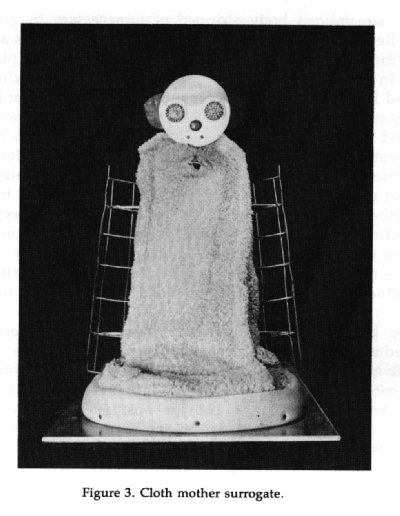 And they weren't even cute -- look at that scary cloth monkey mama!
At the time, the scientific theory behind mother-infant bonding predicted that the wire monkey would be the preferred mother, as "she" would have the food. And women of the day were told not to coddle their babies (i.e. hold them) as it would spoil them.
The infant monkeys overwhelmingly preferred to hang out with the cloth monkey moms.
So that upended some of the goofball ideas that infants are little Machiavellis. But Harlow wasn't done.
As a follow-up, Harlow put infant macaques with either a cloth monkey surrogate or a wire one. The ones with the wire mothers exhibited signs of distress, even though they gained weight at the same rate as the ones with cloth moms. And even more, after the study was officially over, they just weren't right in the head.
This is to say, all it takes to be a good macaque mom is just showing up and being snuggly. And while human infants have a much broader range of needs, I'm pretty sure that showing up and being snuggly is pretty much the foundation of being a good parent -- even if you don't have a whole lot more to provide at the time.
There are a million choices moms (and dads, but let's face it, moms in particular) have to make based on what is right for their families and lives, and there are a million cranks who want to judge those choices. This is not a place for those crankypants. Your method of raising your kid is the best for you and your family, not necessarily mine or theirs (unless, you know, you're a child molester or abuser, but the audience I'm intending this for are, like me, well-meaning people).
This blog is about how you don't have to be perfect to do well, because we don't live in a perfect world, we aren't perfect people, and honestly, when it comes down to it, we don't want our kids to be perfect as much as we want them to be interesting anyway.
Subscribe to:
Comments (Atom)